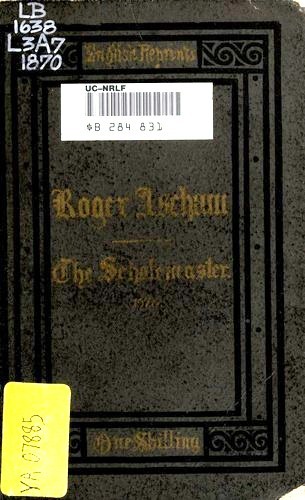
The scholemaster
Roger Ascham
Summary (Spoiler-Free)
In 'The Scholemaster,' Roger Ascham presents a pioneering treatise on education and pedagogy from the Renaissance perspective. Delving into the philosophy of teaching, Ascham emphasizes the importance of moral and intellectual development in students. With a blend of personal anecdotes and educational theory, this work serves as both a guide for educators and a reflection on the societal role of learning during a transformative time in history.
Who Should Read This
If you have a passion for education and the philosophical underpinnings of learning, this book will resonate with you. Its insights into teaching and the development of the mind are particularly engaging for those who appreciate historical perspectives on pedagogy.
Frequently Asked Questions
Is 'The Scholemaster' part of a series, and how should it be read in relation to other works?+
'The Scholemaster' is a standalone work, meaning readers can approach it without needing to delve into any preceding or subsequent texts. Roger Ascham’s writing can be appreciated independently, but for those interested in the evolution of educational thought, reading this alongside other Renaissance educational writings may provide a richer context. It stands as a significant contribution to the philosophy of education, reflecting the ideas of its time, and its insights remain relevant to contemporary discussions on teaching and learning.
What audience is this book suitable for, and are there any content notes to be aware of?+
'The Scholemaster' is primarily aimed at educators, scholars, and anyone interested in the philosophy of education. Its content is appropriate for a wide audience, though readers should be prepared for the historical context in which it was written, which may include references and ideas reflective of 16th-century norms. While it does not contain modern controversial themes, readers should approach it with an understanding of its time to fully appreciate its insights into morality and intellectual development.
Are there any adaptations of 'The Scholemaster' available in audiobook or film format?+
As of now, 'The Scholemaster' has not been widely adapted into film or modern audiobook formats. However, there may be some audio versions available, particularly in educational or historical contexts. The text is often studied in academic settings, and readers can find various analyses and discussions that engage with its themes online. For those interested in auditory learning, checking platforms that specialize in classic literature might yield an audiobook version, but it is not a common adaptation.
What sets 'The Scholemaster' apart within the philosophy genre?+
'The Scholemaster' distinguishes itself in the philosophy genre through its practical application of educational theory. While many philosophical texts focus on abstract concepts, Ascham's work is grounded in real-world teaching experiences and moral considerations, offering a unique blend of theory and practice. Additionally, its historical context as a Renaissance text provides a lens through which modern readers can explore the evolution of educational philosophies, making it a rich resource for understanding the foundations of contemporary education.
What type of reader is likely to enjoy 'The Scholemaster'?+
Readers who have a keen interest in education, philosophy, and historical perspectives are likely to find 'The Scholemaster' particularly engaging. Those who appreciate reflective writing that intertwines personal narrative with educational theory will enjoy Ascham's insights. Additionally, educators and students of pedagogy may find this work not only thought-provoking but also practically applicable to their own teaching philosophies and methodologies.
Similar Books You'll Love

0.0(0 ratings)
Rate this book:
Book at a Glance
~1 hr 27 min to read
- Pages
- 82
- First published
- 1571
- Original language
- EN