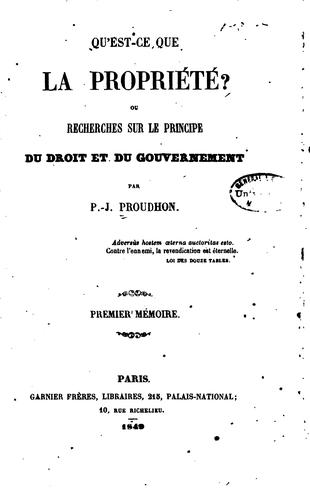
Qu'est-ce que la propriété?
P.-J. Proudhon
Summary (Spoiler-Free)
In 'Qu'est-ce que la propriété?', P.-J. Proudhon delves into the philosophical underpinnings of property and ownership, challenging traditional notions with his provocative assertion that 'property is theft.' This seminal work critiques the economic and social consequences of property ownership, urging readers to reconsider the relationship between individuals and their possessions. Proudhon's exploration of these themes invites deep reflection on justice, freedom, and the structure of society, making it a cornerstone of modern political thought.
Who Should Read This
This book is particularly suited for readers who are passionate about political philosophy and the intricacies of social justice. Those who appreciate thought-provoking discussions and historical context will find Proudhon's arguments both illuminating and challenging.
Frequently Asked Questions
What is the reading order for Proudhon's works?+
While 'Qu'est-ce que la propriété?' stands alone, understanding Proudhon's broader philosophical framework may enhance your reading experience. It is beneficial to explore his other writings on social and political theory to grasp the evolution of his thought. However, this book can be appreciated without prior knowledge of his other works, making it accessible for new readers interested in philosophical discourse.
Who is the target audience for this book?+
This book primarily targets readers interested in philosophy, political theory, and social justice. It is suitable for students, scholars, and general readers who are keen on exploring foundational ideas about property and its implications in society. However, due to its dense philosophical concepts and historical context, it may be best suited for those with some prior exposure to philosophical texts.
Are there any adaptations or audio formats available?+
As of now, 'Qu'est-ce que la propriété?' has not been adapted into a film or television series. However, it is available in various print editions and may also be found in audio format, allowing for a more flexible reading experience. Audiobooks can be particularly beneficial for those who prefer to engage with complex philosophical texts while multitasking or commuting.
What makes this book distinct within the philosophy genre?+
'Qu'est-ce que la propriété?' stands out due to its radical critique of property rights and its early articulation of anarchist thought. Unlike many philosophical works of its time, Proudhon boldly challenges the status quo, making it a foundational text in both socialist and libertarian discourses. Its blend of theoretical analysis and social commentary sets it apart from more traditional philosophical treatises, providing a unique perspective on ownership and its societal impact.
What kind of reader is likely to enjoy this book?+
Readers who enjoy engaging with complex, challenging ideas will likely find 'Qu'est-ce que la propriété?' appealing. It resonates with those who appreciate philosophical debates about morality, ethics, and societal structures. Individuals interested in the historical context of political philosophy, as well as those seeking to understand the roots of contemporary discussions on property and justice, will find this work particularly rewarding.
Similar Books You'll Love

0.0(0 ratings)
Rate this book:
Book at a Glance
~4 hr 24 min to read
- Pages
- 248
- First published
- 1840
- Original language
- PT