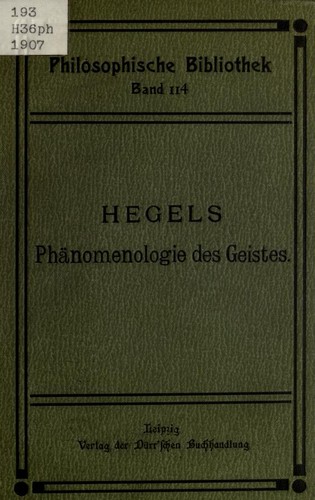
Phänomenologie des Geistes
Georg Wilhelm Friedrich Hegel
Summary (Spoiler-Free)
In 'Phänomenologie des Geistes', Georg Wilhelm Friedrich Hegel embarks on a profound exploration of consciousness and the development of self-awareness. Through a methodical examination of various forms of consciousness, Hegel illustrates how human experience evolves from simple sensory perception to complex thought. This work serves as a foundational text in philosophical thought, delving into themes of reality, identity, and the interplay between the individual and society. Hegel's intricate arguments and dialectical method challenge readers to reconsider their understanding of knowledge and existence.
Who Should Read This
If you have a passion for deep philosophical inquiry and enjoy challenging your perceptions of reality, this book is for you. Its intricate analysis and rigorous examination of consciousness will resonate with those who appreciate the complexities of thought and the human experience.
Frequently Asked Questions
Is 'Phänomenologie des Geistes' part of a series, and how does it fit into Hegel's body of work?+
This book is a standalone work and not part of a series. However, it is a crucial piece within Hegel's larger philosophical framework. Hegel's ideas often build upon one another, and 'Phänomenologie des Geistes' serves as a foundational text that introduces key concepts which he later elaborates on in his other works, such as 'Science of Logic' and 'The Philosophy of Right'. Reading this text can enhance your understanding of Hegel's overall philosophy and his dialectical method.
What audience is this book appropriate for, and are there content notes I should be aware of?+
This book is primarily suited for readers with an interest in philosophy, particularly those familiar with or willing to engage with complex theoretical concepts. It is often studied in academic settings and may not be the best choice for casual readers without a background in philosophy. The text delves into themes of consciousness, identity, and societal structures, which may evoke deep reflection. Readers should be prepared for dense language and intricate arguments, as Hegel's writing style can be challenging.
Are there any adaptations or alternative formats available for this book?+
While 'Phänomenologie des Geistes' is primarily available in print, there are several audiobook versions and digital formats that cater to various preferences. These formats can provide listeners with the opportunity to engage with the text in a different way, which may be beneficial given Hegel's complex ideas. However, there are no film adaptations, as the nature of the material is philosophical rather than narrative, making it less suitable for visual storytelling.
What distinguishes 'Phänomenologie des Geistes' within the field of philosophy?+
This work is notable for its innovative approach to understanding consciousness and self-awareness through a dialectical method. Hegel's exploration of the development of consciousness from basic perception to higher forms of thought is a significant contribution to existential and epistemological discussions. The text is also recognized for its historical context, as it addresses the philosophical climate of the early 19th century, marking a shift towards modern philosophical thought. Its depth and complexity set it apart from other philosophical works, making it a cornerstone for students and scholars alike.
What type of reader tends to enjoy this philosophical work?+
Readers who enjoy philosophical discourse, particularly those with an interest in existentialism, idealism, and the development of consciousness, will likely find this work compelling. It appeals to individuals who are willing to invest time and effort into understanding intricate ideas and who appreciate the nuances of dialectical reasoning. Academic scholars, philosophy students, and those looking to deepen their grasp of complex philosophical concepts will benefit the most from engaging with Hegel's challenging yet rewarding text.
Similar Books You'll Love

0.0(0 ratings)
Rate this book:
Book at a Glance
~10 hr 36 min to read
- Pages
- 598
- First published
- 1907
- Original language
- DE