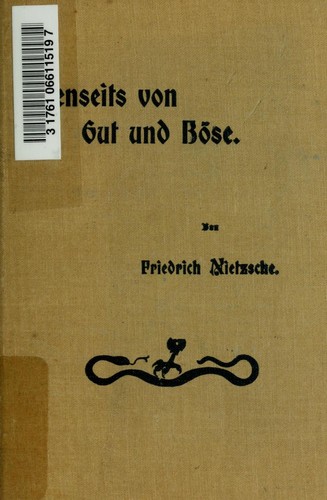
Jenseits von Gut und Böse
Friedrich Nietzsche
Summary (Spoiler-Free)
In 'Jenseits von Gut und Böse,' Friedrich Nietzsche challenges traditional moral values and the philosophical foundations of Western thought. He critiques dogmatism in philosophy and religion, urging readers to transcend conventional notions of good and evil. With incisive wit and provocative ideas, Nietzsche invites an exploration of human instincts and the complexities of moral judgment, advocating for a more nuanced understanding of truth and morality beyond simplistic binaries.
Who Should Read This
This book is particularly suited for readers who relish deep philosophical inquiry and are open to questioning established norms. If you enjoy challenging your perspectives and exploring the intricacies of human morality, Nietzsche's work will resonate with you.
Frequently Asked Questions
Is 'Jenseits von Gut und Böse' part of a series, and how does it fit within Nietzsche's body of work?+
'Jenseits von Gut und Böse' is a standalone work and not part of a series. This book is pivotal in Nietzsche's philosophy, written after 'Thus Spoke Zarathustra' and before 'On the Genealogy of Morals.' It serves as a bridge between his earlier and later works, encapsulating his critiques of morality and knowledge that are foundational to his philosophical outlook. Readers often find that engaging with this book provides a clearer understanding of Nietzsche's critique of traditional values, making it essential for anyone studying his philosophy.
What is the target audience for this book, and are there any content considerations?+
'Jenseits von Gut und Böse' is primarily aimed at readers with an interest in philosophy, ethics, and existential thought. It addresses complex themes such as morality, power dynamics, and the nature of truth, which may be challenging for casual readers. Additionally, Nietzsche’s provocative style and critical approach towards established norms may not appeal to everyone. Readers should be prepared for dense philosophical arguments and a departure from conventional moral reasoning. As such, it's best suited for those who enjoy engaging with difficult concepts and have a background or strong interest in philosophical discourse.
Are there any adaptations or additional formats available for this book?+
'Jenseits von Gut und Böse' has been translated into numerous languages and is widely available in various formats, including paperback, hardcover, and e-book editions. Additionally, there are several audiobooks available that bring Nietzsche’s thoughts to life through skilled narration. While there have been no direct film adaptations of this specific work, Nietzsche’s ideas have influenced many filmmakers and artists, which can provide a broader context for understanding his impact on culture and philosophy.
What makes 'Jenseits von Gut und Böse' distinct within the philosophical genre?+
This work is distinct because it directly confronts the prevailing philosophical dogmas of its time. Nietzsche's approach is characterized by a blend of sharp critique and poetic prose, making complex ideas more accessible and engaging. He emphasizes the notion of the 'will to power' and the importance of individual perspective, setting it apart from traditional moral philosophy that often adheres to absolute truths. The book's challenge to the dichotomy of good and evil, and its call for a reevaluation of values, marks it as a seminal text in existential and postmodern thought.
What type of reader is most likely to enjoy 'Jenseits von Gut und Böse'?+
Readers who are drawn to philosophical inquiry, particularly those interested in existentialism, ethics, and the critique of morality, will find this book compelling. It appeals to individuals who enjoy deep, thought-provoking discussions and are willing to explore controversial ideas. If you appreciate literature that challenges societal norms and provokes introspection, Nietzsche's work will likely resonate with your intellectual pursuits.
Similar Books You'll Love

0.0(0 ratings)
Rate this book:
Book at a Glance
~2 hr 23 min to read
- Pages
- 134
- First published
- 1885
- Original language
- EN