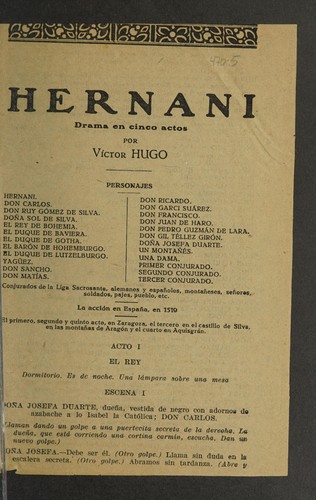
Hernani
Victor Hugo
Summary (Spoiler-Free)
Set against the backdrop of 19th-century Spain, 'Hernani' is a powerful drama that explores themes of love, honor, and rebellion. The story revolves around Hernani, a nobleman turned bandit, who is torn between his passionate love for the beautiful Doña Sol and a fierce desire for revenge against his enemies. As the characters navigate a web of loyalty, betrayal, and political intrigue, Hugo crafts a narrative that challenges societal norms and questions the nature of freedom.
Who Should Read This
If you are drawn to intense character-driven stories that delve into the complexities of love and honor, 'Hernani' is a compelling choice. Fans of classic drama and those with an appreciation for rich language and poetic dialogue will find much to admire in Hugo's work.
Frequently Asked Questions
Is 'Hernani' part of a series or a standalone work?+
'Hernani' is a standalone play by Victor Hugo, first published in 1830. It is not part of any series, which allows readers to engage with the story without needing to familiarize themselves with prior works. This makes it accessible to newcomers to Hugo's writing, as well as those who may be exploring the themes and styles present in his other standalone pieces.
What is the target audience for 'Hernani'?+
'Hernani' is suited for readers who appreciate classic literature, particularly those who have an interest in drama and the historical context of 19th-century European literature. The themes of love, honor, and political conflict may resonate with mature audiences, particularly those who enjoy works that provoke thought and stimulate discussion about societal values and human emotion. Given its poetic language and complex characters, it may be best appreciated by those who have experience with classic texts.
Are there any adaptations of 'Hernani' available?+
Yes, 'Hernani' has been adapted for various forms of media beyond its original stage play. There are several recorded theatrical performances available, which capture the essence of the play’s dramatic elements. Additionally, some film adaptations have attempted to bring Hugo's work to the screen, though the availability may vary by region. For those who prefer audio formats, audiobooks of 'Hernani' are also accessible, allowing listeners to experience the rhythmic language and emotional weight of the dialogue.
What distinguishes 'Hernani' within the drama genre?+
'Hernani' is notable for its romanticism, a movement that emphasizes emotion, individualism, and the glorification of the past. Victor Hugo's work stands out due to its passionate characters and intense moral dilemmas, which challenge the status quo of society. The play's exploration of themes such as love versus duty and the conflict between personal desires and societal expectations adds depth, making it a crucial text in understanding the evolution of modern drama and its departure from classical traditions.
What kind of reader is likely to enjoy 'Hernani'?+
Readers who find enjoyment in layered narratives that blend emotional depth with societal critique will likely appreciate 'Hernani'. Those who are intrigued by the exploration of complex character relationships and moral quandaries will find Hugo's work engaging. Additionally, individuals who admire poetic language and dramatic tension in storytelling are well-suited for this piece, as it captures the essence of human passion and conflict in a richly textured format.
Similar Books You'll Love
0.0(0 ratings)
Rate this book:
Book at a Glance
~1 hr 37 min to read
- Pages
- 91
- First published
- 1830
- Original language
- EN