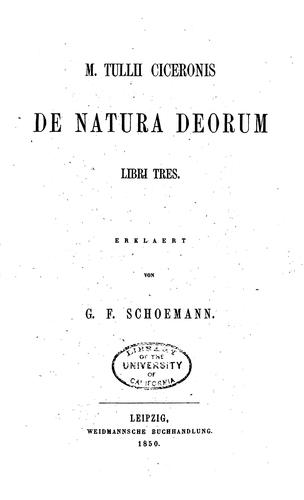
De Natura deorum
Cicero
Summary (Spoiler-Free)
In 'De Natura Deorum,' Cicero explores the nature of the gods and the role they play in human existence. Through a series of dialogues, he delves into the philosophical debates surrounding religion, ethics, and the universe. This work combines philosophical inquiry with rhetorical mastery, offering insights into the beliefs and practices of ancient Roman society while challenging the reader to reflect on their own understanding of divinity.
Who Should Read This
If you have an interest in ancient philosophy or the intersection of religion and ethics, this book is a thought-provoking read. Cicero's eloquent arguments and engaging dialogue style make it particularly appealing for those who enjoy exploring deep philosophical questions.
Frequently Asked Questions
What is the reading order for Cicero's works, and is 'De Natura Deorum' part of a series?+
'De Natura Deorum' is a standalone work by Cicero and does not belong to any series. As a significant piece in his oeuvre, it can be read independently, although familiarity with other works by Cicero, such as 'De Re Publica' and 'Tusculanae Disputationes,' can enrich the reader's understanding of his philosophical stance and rhetorical style. Readers may choose to explore these works sequentially for a broader comprehension of his thoughts on philosophy and politics, but it is not necessary for enjoying 'De Natura Deorum.'
What audience is this book appropriate for, and are there any content notes I should be aware of?+
'De Natura Deorum' is primarily targeted at readers with an interest in philosophy, particularly those who appreciate classical works. It delves into complex themes surrounding theology, ethics, and metaphysics, which may not be suitable for younger audiences or those looking for light reading. The text assumes a certain level of familiarity with philosophical concepts and ancient Roman cultural context, so it may be more accessible to college students, scholars, or enthusiastic philosophy readers. The discussions can be dense and require careful consideration, which might be challenging for some readers.
Is 'De Natura Deorum' available in audiobook format or has it been adapted into other media?+
Yes, 'De Natura Deorum' is available in audiobook format, allowing listeners to engage with Cicero's philosophical arguments in an auditory format. Various translations and interpretations can be found, making it easier for diverse audiences to access the text. As for adaptations, while it has not been directly translated into film or television, its themes and ideas have influenced various works in literature and philosophy, making it a significant reference point for discussions on the nature of divinity and ethics.
What makes 'De Natura Deorum' distinct within the philosophy genre?+
'De Natura Deorum' stands out in the philosophy genre due to its incorporation of dialogue and rhetorical techniques, which make the philosophical arguments more engaging and accessible. Cicero's ability to weave in personal beliefs and cultural context allows for a unique exploration of ancient thought that reflects the complexities of Roman religious practices. Unlike many philosophical texts that present abstract theories, Cicero's work also serves as a commentary on the moral implications of belief in the gods, offering a blend of rhetoric and philosophy that encourages readers to reflect on their own understanding of spirituality.
What type of reader tends to enjoy 'De Natura Deorum'?+
Readers who are drawn to philosophical discourse, particularly those with an interest in ancient history and theology, are likely to appreciate 'De Natura Deorum.' This book appeals to those who enjoy deep, intellectual conversations about the existence of deities and the ethical ramifications of belief systems. Additionally, fans of classical literature and rhetoric will find Cicero's style and argumentation compelling, making it a satisfying read for anyone eager to engage with timeless questions about faith and reason.
Similar Books You'll Love

0.0(0 ratings)
Rate this book:
Book at a Glance
~4 hr 40 min to read
- Pages
- 263
- First published
- 1718
- Original language
- EN