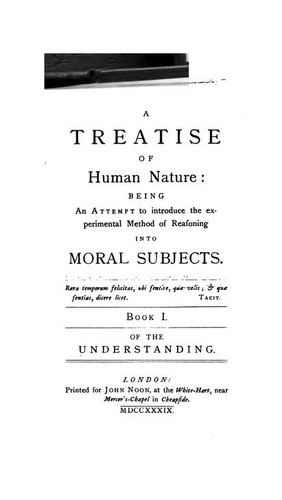
A treatise of human nature
David Hume
Summary (Spoiler-Free)
In 'A Treatise of Human Nature,' David Hume delves into the complexities of human psychology, exploring the nature of emotions, moral judgments, and the principles of human understanding. His work challenges established philosophical norms by emphasizing empiricism and the role of experience in shaping our beliefs. Through a rigorous analysis, Hume seeks to illuminate the underlying mechanisms of human behavior and thought, making a significant contribution to the field of philosophy.
Who Should Read This
If you enjoy deep philosophical inquiries that question the foundations of human understanding, this book may resonate with you. It's particularly appealing to those who appreciate a blend of analytical rigor and accessible prose.
Frequently Asked Questions
What is the reading order for David Hume's works?+
'A Treatise of Human Nature' is a standalone work, meaning it does not belong to a series. However, it is beneficial to read it in conjunction with Hume’s other writings, such as 'An Enquiry Concerning Human Understanding' and 'An Enquiry Concerning the Principles of Morals.' These texts expand on themes present in the Treatise, providing a broader context for Hume's philosophical ideas. For those new to Hume, starting with the Enquiries might provide a more digestible introduction before tackling the more complex arguments in the Treatise.
Is this book appropriate for all audiences?+
While 'A Treatise of Human Nature' is a foundational text in philosophy, it is most suitable for readers who have some familiarity with philosophical concepts. The language and ideas can be challenging, particularly for those who are not accustomed to analytical philosophy. Readers may find it beneficial to have some background in philosophy or to approach the text with a willingness to engage deeply with abstract concepts. It can be a rewarding read for students, scholars, or anyone interested in the intricacies of human thought and behavior.
Is there an audiobook version or any adaptations available?+
Yes, 'A Treatise of Human Nature' is available in various formats, including audiobook. The audiobook format can be particularly useful for those who prefer to engage with philosophical texts through listening, allowing for a different way to absorb Hume's arguments. Additionally, there are numerous scholarly discussions and lectures available online that explore Hume’s ideas, making the content more accessible for those who may find the text itself challenging.
What makes this book distinct within the philosophy genre?+
'A Treatise of Human Nature' stands out due to Hume’s unique approach to empiricism and skepticism. Unlike many philosophers of his time who relied heavily on rationalism, Hume emphasizes the importance of sensory experience and observation in understanding human nature. His writing style is also notable for its clarity and wit, facilitating a more engaging read compared to other dense philosophical texts. Hume’s exploration of the interplay between reason and emotion has left a lasting impact on the field, cementing this work as a cornerstone of modern philosophy.
What kind of reader tends to enjoy this book?+
Readers who are curious about the foundations of human thought and behavior are likely to appreciate this work. Those who enjoy philosophical debates about morality, knowledge, and emotion will find Hume's inquiries particularly engaging. Additionally, students of philosophy or psychology who seek to understand the historical development of these fields will benefit from Hume's insights. This book appeals to those who enjoy critical thinking and are willing to grapple with complex ideas about human nature.
Similar Books You'll Love

0.0(0 ratings)
Rate this book:
Book at a Glance
~5 hr 45 min to read
- Pages
- 324
- First published
- 1739
- Original language
- —